

BDNY (Boutique Design New York) was packed this year. Not “pretty good turnout” packed. Shoulder-to-shoulder, can’t-get-down-the-aisle packed, the busiest I’ve seen it, foot-traffic-wise, since before COVID.
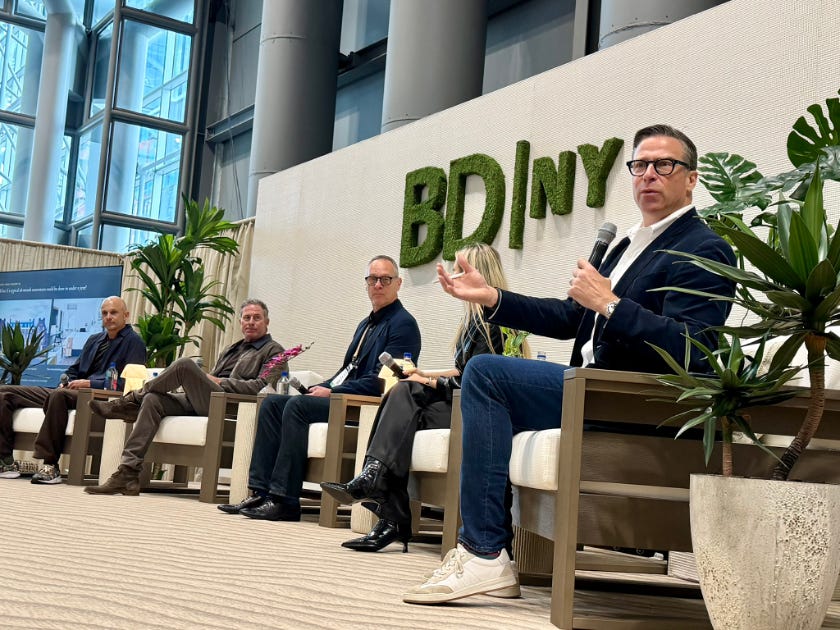
Does that mean we’re about to be hit by a CapEx tsunami in hospitality? I’m not sure. (The hamsters running around in my head have opinions on credit cycles, and I’ll save those for The Ledger.) But people are clearly rethinking how to speed things up and get to market faster. That was the conversation in the aisles, at the booths, and on both panels I had the privilege of moderating.
The other thing I noticed: so many changes in positions and seats. People between roles, people in new roles, people who’d moved across the table from where they sat last year. That can feel unsettling. It’s also a great reason to show up. BDNY is where you connect, mentor, and help fill those seats in a world that keeps reshuffling.
So I spent the weekend doing two things. On Saturday, BERMANFALK hosted a private panel and tour at the new Kimpton Era Midtown. On Sunday, I moderated a main stage session called “The Fast-Track Hotel: Lessons From Accelerated Model Room and Hotel Delivery.” One was a case study. The other was a playbook. Together, they answered the question everybody was asking on the show floor.
A 529-room hotel that still feels personal
BERMANFALK manufactured all of the guestroom furniture and millwork at Kimpton Era. I’m telling the story because the people behind it deserve the credit, and because what they figured out applies to every hotel being built or renovated right now.
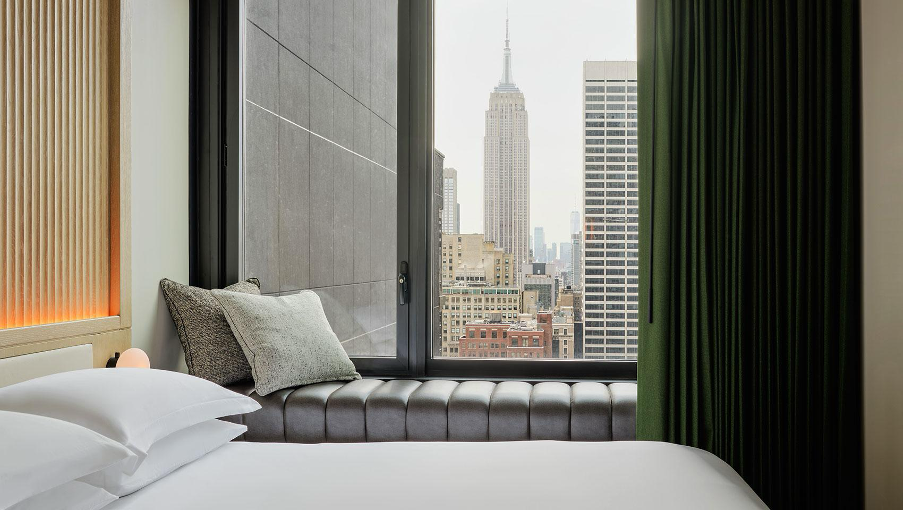
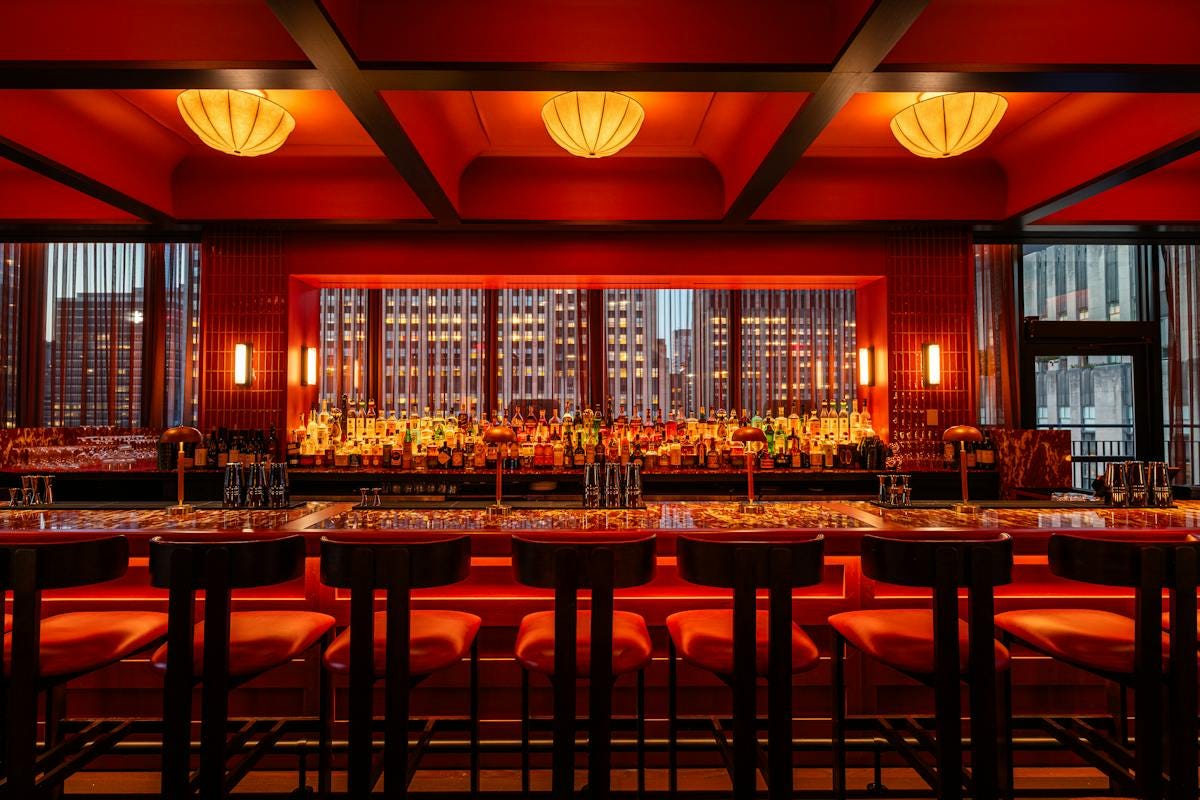
Kimpton was one of the first brands to prove that boutique hospitality could scale without losing the human touch. Kimpton Era, at 32 West 48th Street, a short walk from Rockefeller Center, tests that idea at New York scale: 529 rooms, four food and beverage concepts, and a rooftop bar called Jade Rabbit with the kind of Midtown view that makes you forget you were just fighting crowds on Sixth Avenue.
The panel brought together the three sides of the table. Anna Ng, Vice President of Design at Extell Development Company, spoke for ownership. Diana Martinez, Head of Design at IHG Hotels & Resorts, spoke for the brand. Hilary Kroll, Partner at INC Architecture & Design, spoke for the design team.
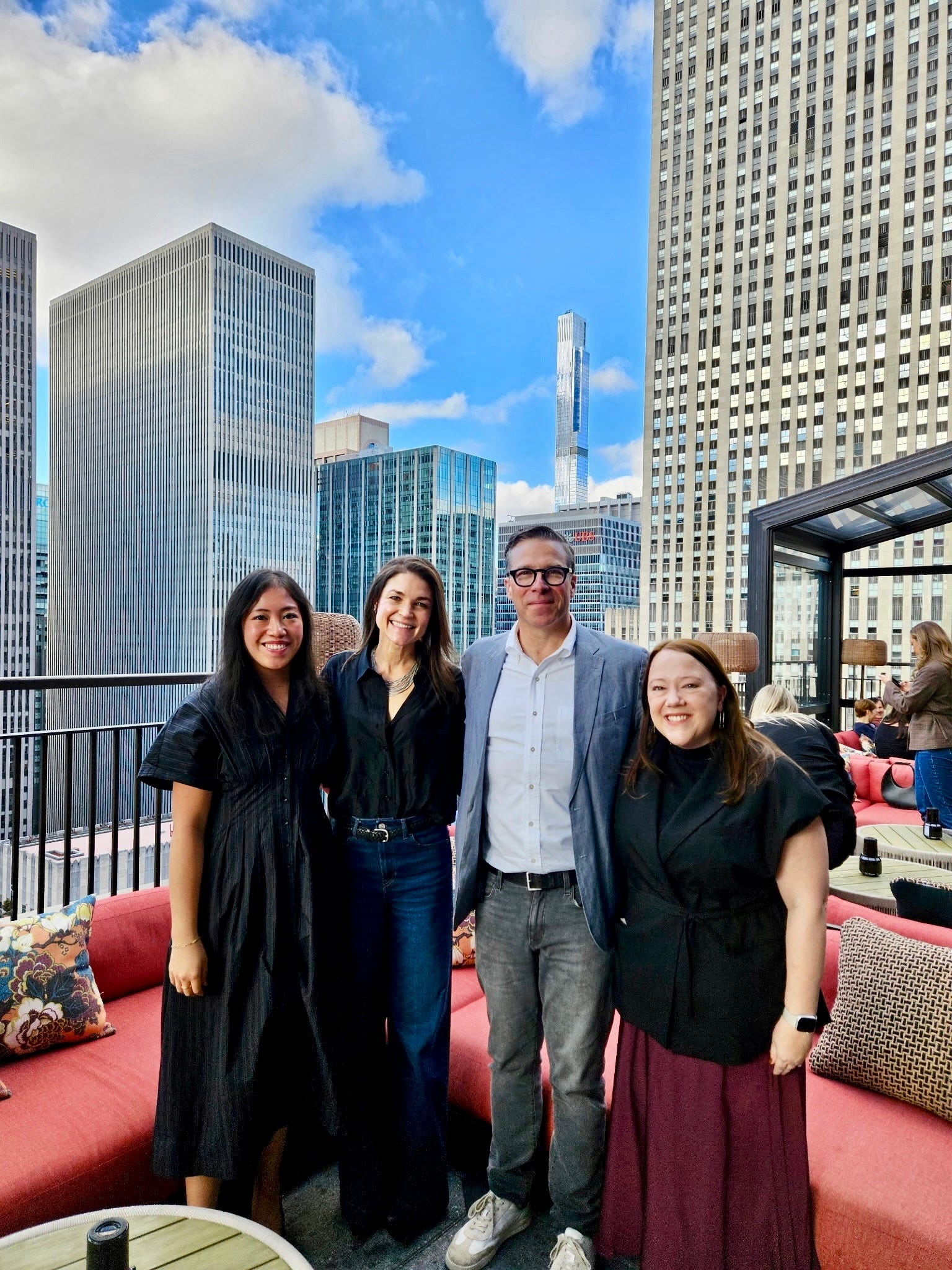
Anna walked us through why Extell chose a hotel for this site at all. The numbers favored it over residential or mixed use, the IHG relationship was already there, and putting a Kimpton next to Rockefeller Center was too good to pass up. Then COVID hit. Her point, paraphrased: once you’ve dug the hole, you don’t walk away from it. You commit and you keep going. Add in 40-foot trucks making deliveries in winter while half the planet comes to see the Christmas tree, and you start to understand what “commitment” means on a Midtown site.
Hilary described the design brief as bringing the Kimpton personality to New York City: a little uptown polish, a little downtown edge. That tension shows up everywhere, from the guestroom palette to the restaurants, which each have their own identity but share a kit of parts borrowed from classic New York eateries. Big wooden bars. Stone mosaic floors. Warm light.
Diana framed the relationship between owner, brand, and designer as healthy tension. Ownership protects the investment. Design and brand protect the guest experience. When those teams work through it together instead of around each other, you get a better hotel.
Mock it up. Then mock it up again.
Here’s where my FF&E brain lit up.
The guestrooms are compact, so the team asked one built-in millwork wall to do a lot of work: headboard, nightstand, desk, closet, and vanity, all in one run. Add a window bench and luggage storage, and every inch has a job. When every inch has a job, every junction where two materials meet is visible. So the team mocked up relentlessly. Three rounds of model room work. Five different versions of how the black steel sliding bathroom door track meets the tile.
There were also moments to innovate with materials. The scalloped headboard is a good example. The team moved to a cast resin, molded from real wood grain, to minimize movement as temperature and humidity swing through a New York year. On the tour, nobody could tell the difference. (I watched people run their hands over it trying to figure it out. I enjoyed that more than I should have.)
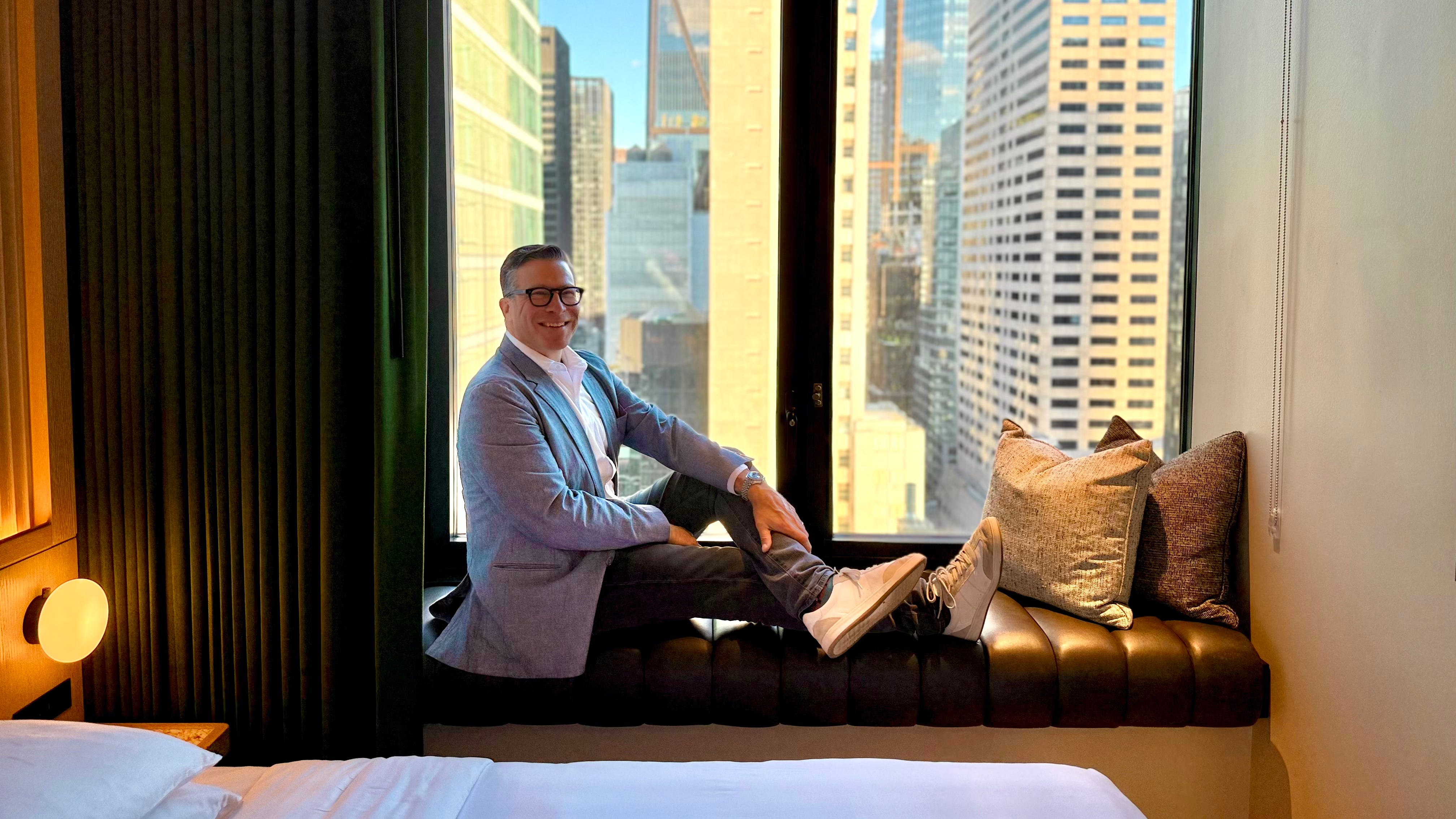
A few other details worth stealing. The corner guards were designed in from the start and finished to match the shower door hardware, so the protection looks intentional rather than an afterthought. And when owner and designer each loved a different bathroom floor tile, they used both, alternating room by room, so a repeat guest gets a slightly different room the next time. At 529 rooms, that’s not a small decision.
The installation lesson I keep coming back to is about the closet and vanity millwork. Install and level the plinth base first, then use it as the reference point for everything that sits on top. Skip that step, and small gaps creep in as you move down the run. On site, the team checked alignment with lasers. As Diana put it, at this scale small oversights become recurring problems. A mistake in the model room is a lesson. The same mistake in 529 rooms is a punch list.
Sunday: the Fast-Track Hotel
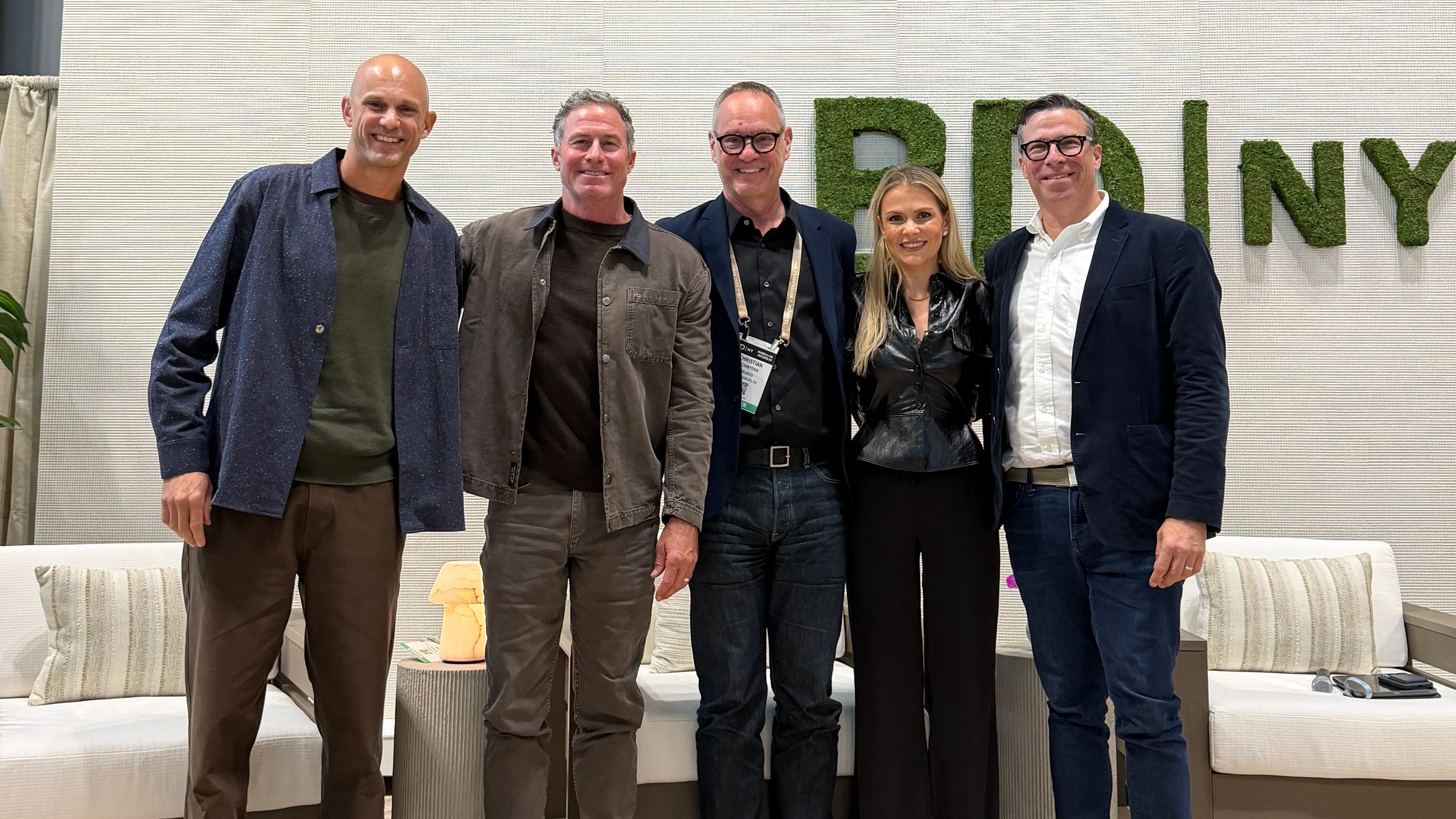
Sunday morning on the BD Main Stage, I asked four people who sit in four different seats to tell the truth about speed. Dane Patunoff of KHP Capital Partners brought the ownership view. Bryce Sprecher of Summa International brought purchasing. Christian Schnyder, founder of Beleco Design, brought design. Anna Peretz brought the brand perspective from her years at Marriott and Sonesta.
We started with a baseline everyone in the room recognized. A typical FF&E renovation, from the day the owner brings the team on board through design, purchasing, model room, rollout, and install, runs about 70 weeks. Roughly 16 months. Design, then bid, then value engineer, then rebid, then approve. Every handoff waits on the one before it.
Then we asked a simple question: what if you kept the same twelve steps, but front-loaded the intelligence?
What two months looks like. What 20 weeks looks like.
Production, shipping, and install don’t get shorter. The factory still needs its weeks. The boat still takes its time. What gets shorter is everything in front of production: the bidding, the leveling, the approvals, the redraws. Bring the long-lead suppliers in at concept, alongside the designer, not after the bid. Set the budget by category before design starts and share it open book. Make decisions in the model room workshop with every decision-maker in the room.
Do that, and our math showed you can pull about 10 weeks out of the path to the model room and another 10 out of the rollout. Seventy weeks becomes 50.
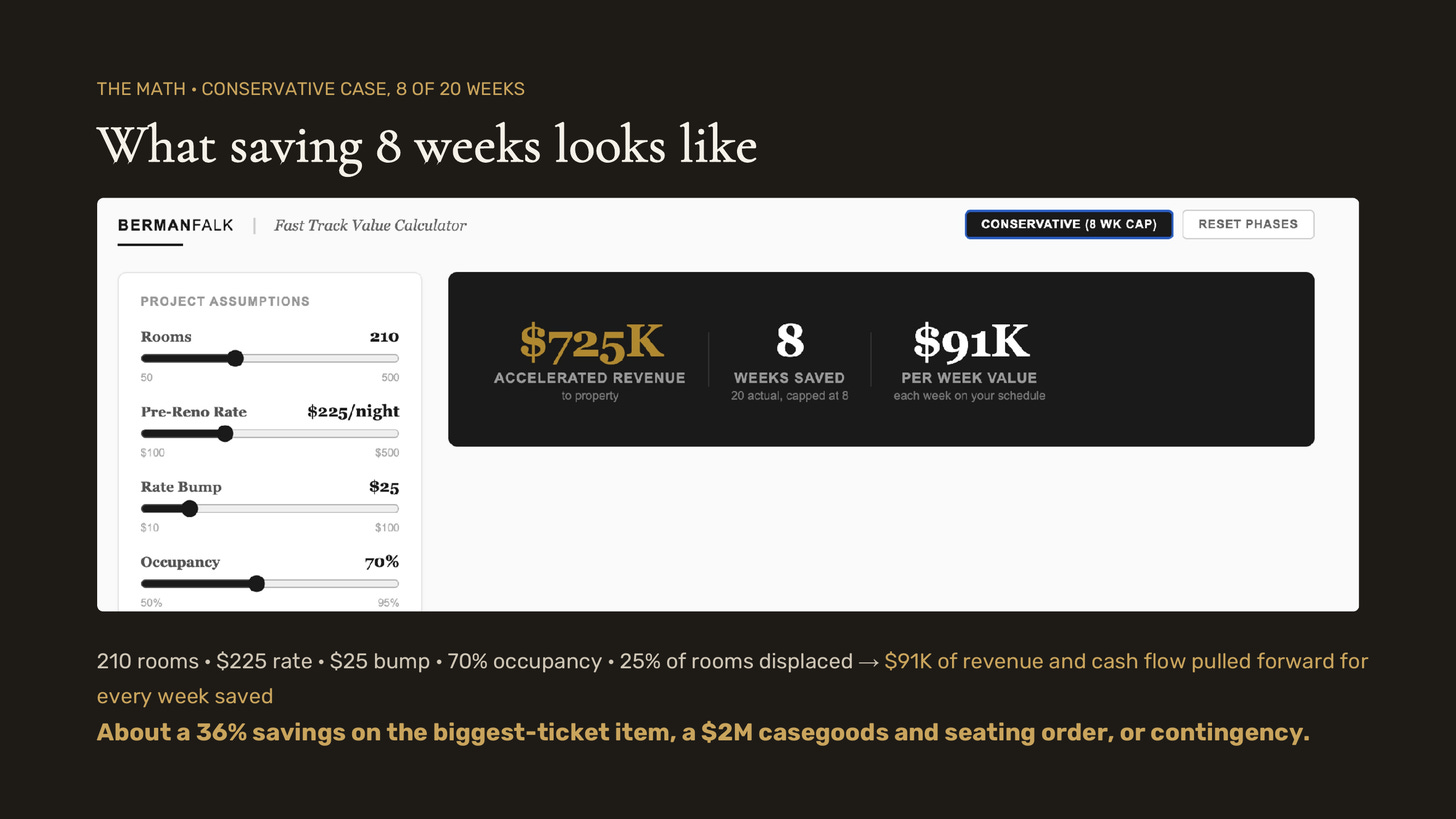
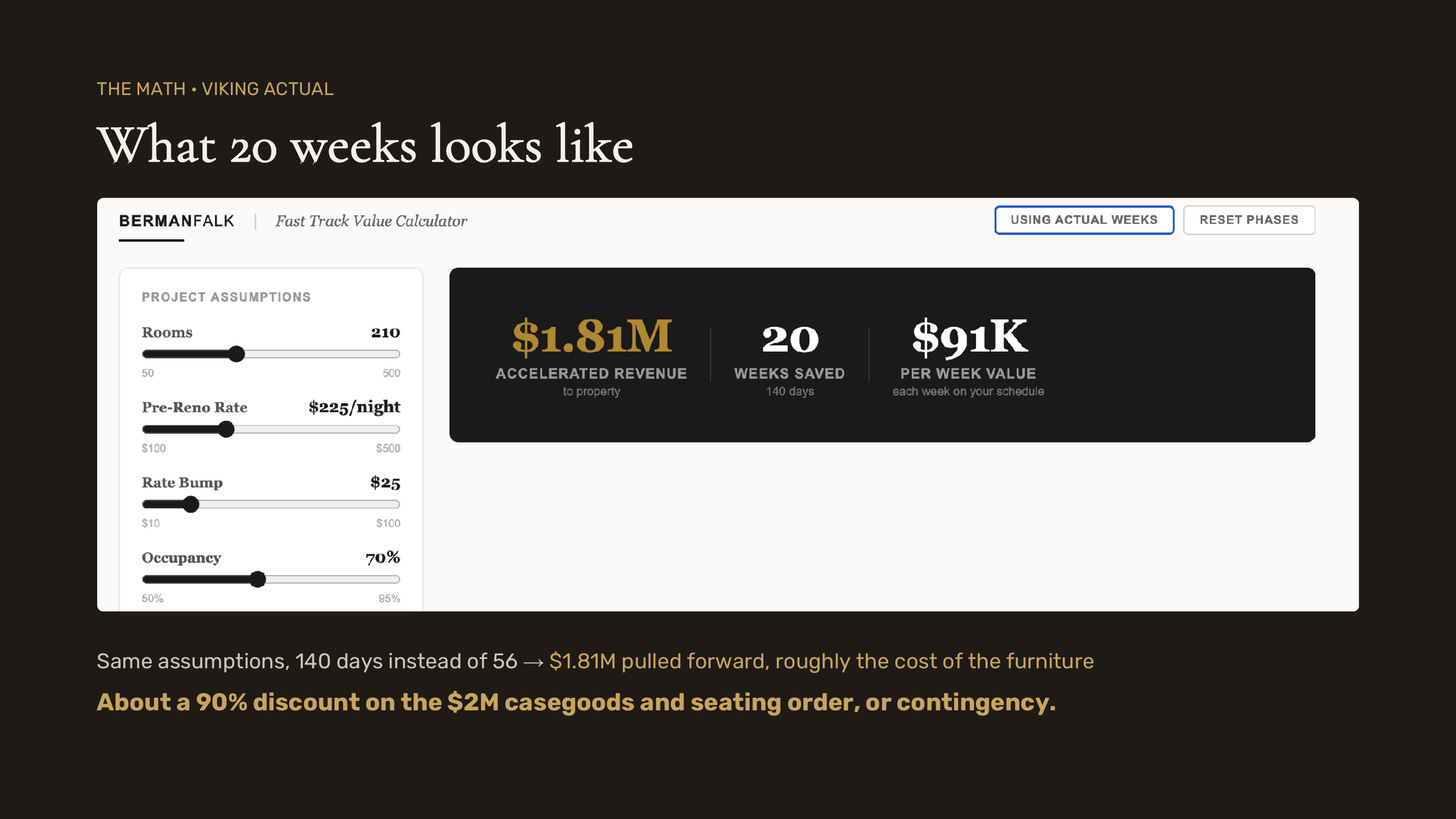
Here’s why that matters to an owner. Using a conservative set of assumptions for a 210-room hotel ($225 rate, a $25 bump after renovation, 70 percent occupancy), every week saved pulls about $91,000 of revenue and cash flow forward.
Save eight weeks, and that’s roughly $725,000. On a $2 million casegoods and seating order, that’s a bit more than a third of the furniture.
Save 20 weeks, and it’s about $1.81 million. Roughly the cost of the furniture.
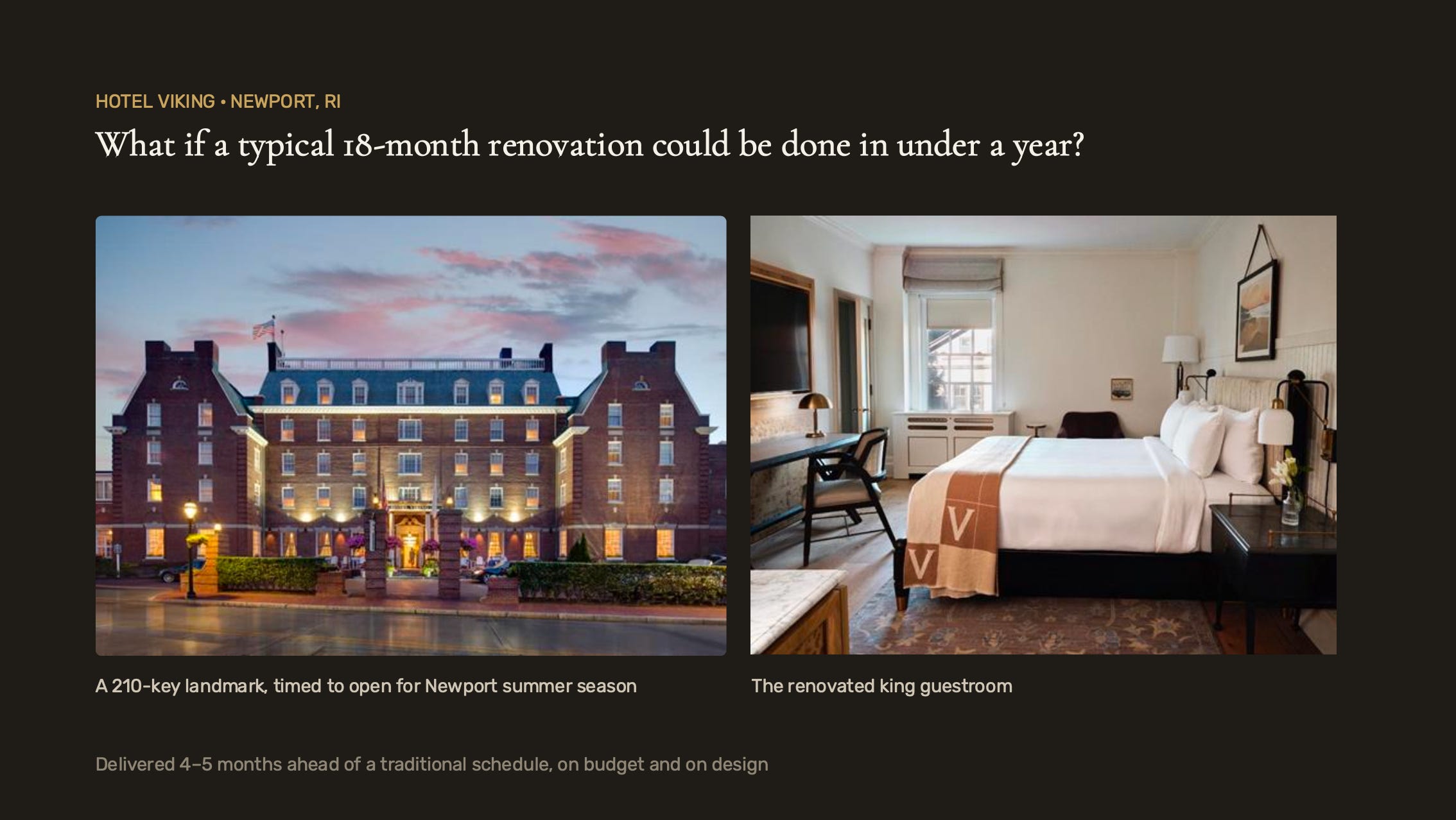
Dane brought the real-world version: the Hotel Viking in Newport, Rhode Island, a 210-key landmark that ran this way, opened four to five months ahead of a traditional schedule, and made the Newport summer season and Jazz Fest instead of waiting another year. No value engineering. No cost reductions needed.
Speed is a people problem, not a schedule problem
What struck me most was that none of the panelists talked about speed as a scheduling trick. They talked about it as a people problem.
Dane talked about deciding at acquisition whether the model room is the critical path and whether there’s a date you can’t miss. A ski season, a loan covenant, a Super Bowl, a Taylor Swift tour stop. Bryce talked about purchasing staying in the room for pricing conversations so the agreed price, the scope, and the purchase order all stay aligned.
Christian made the case that constraints, when the supplier is at the table from concept, can produce better design, not worse, as long as the design team stays engaged and protects the core idea. And Anna pushed back on the habit of keeping the brand in the dark because owners assume it will slow things down. Bring them in early, summarize the essentials on one page instead of 300 pages of standards, and brands can move faster than people think.
The panel was equally clear about the limits. It’s not for every project. Ground-up projects often have the time. Some vendors can’t start without a purchase order. Some design firms build every detail into their own process, and that’s fine. And skipping the model room doesn’t save time. It just moves the risk to opening day.
The line that stuck with the room: we’re not value engineering. We’re engineering value.
Speed and soul aren’t opposites
Put Saturday and Sunday side by side, and they make one argument. Kimpton Era shows what it takes to get the details right at scale: obsessive mockups, smart material choices, and a team willing to work through healthy tension. The Fast-Track panel shows how to get there faster without skipping any of that.
Speed and soul aren’t opposites. Not if the team decides early, commits with radical intention, and collaborates transparently and relentlessly. The model room is still the moment of truth. You just get there with the right people already in the room.
That’s the process I’ve written about here before and have been evangelizing for a while now, and it’s the one we run at BERMANFALK. Long-lead casegoods and millwork suppliers at the table from concept, budgets set by category and shared open book, and the model room treated as a workshop, not a verdict. It works, and it makes every deliverable better, from the shop drawings to the last room on the last floor.
Only connect
I keep coming back to the show floor. All those people, many in new seats, shaking hands, hugging, laughing, swapping stories about the project that almost broke them. In a business this fragmented, with this many hands touching every room, that’s the real critical path.
E.M. Forster put it in two words in Howards End: only connect.
What will you do differently on your next project? Hit reply. I read every one.
See you next year. Hopefully a little faster.
- Dan