

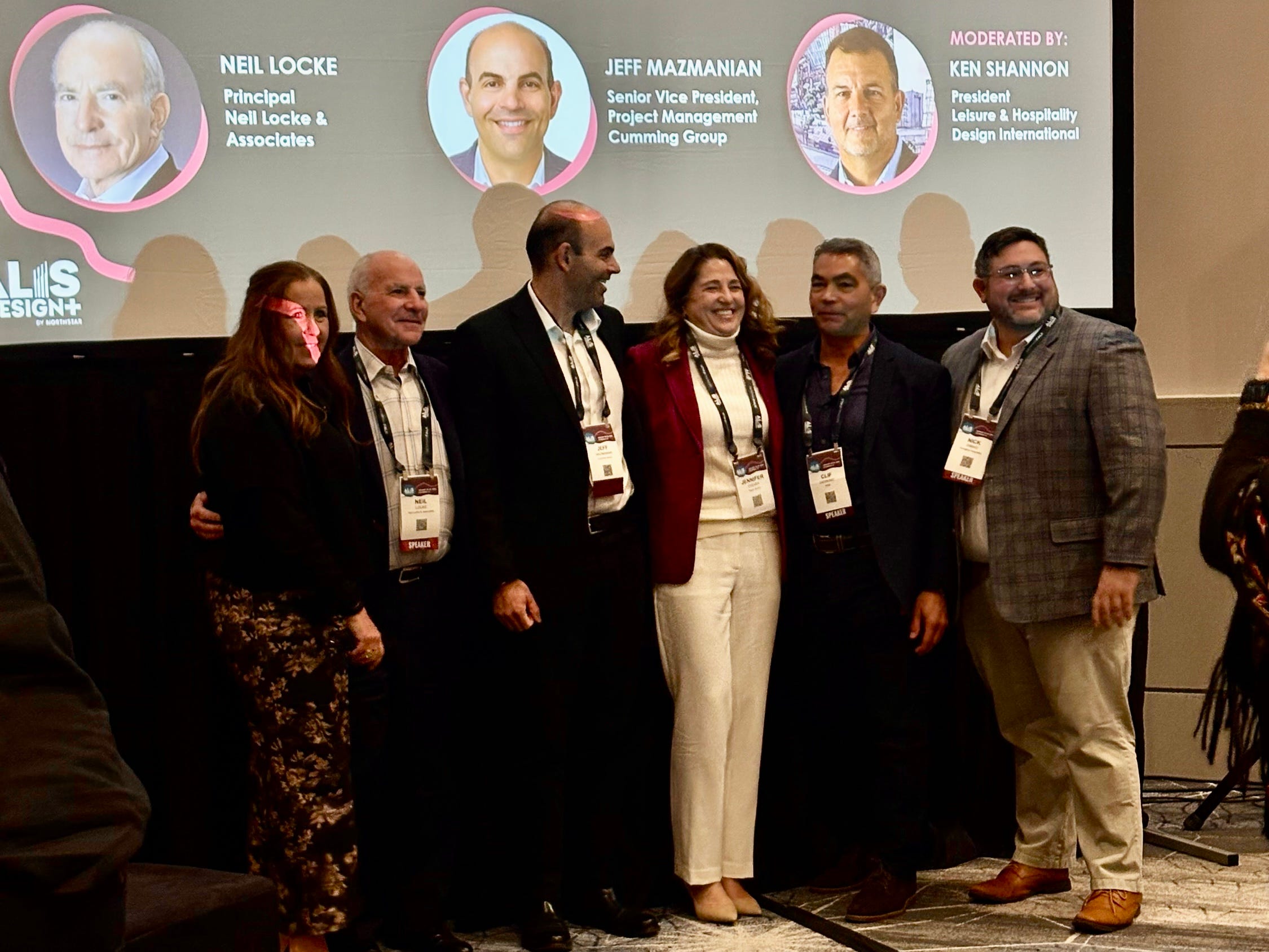
The session, Procurement, Project Management: What to Expect and How to Deflect the Unexpected, was moderated by Karin Harrington, with panelists Jennifer Chesek (Beyer Brown), Clif Dierking (PDSI), Neil Locke (Neil Locke & Associates), Jeff Mazmanian (Cumming Group), and Nick DiMaio (Peregrine Hospitality).
The conversation was practical, honest, and deeply aligned with what I see on real projects every day.
What I appreciated most was how consistently the panel came back to the same core idea:
Get the right people involved earlier.
Start with what Nick aptly called “the BS” - Budget and Schedule.
That alone would be a solid takeaway.
But listening, and then talking with owners, designers, PMs, and procurement teams afterward, it reaffirmed for me that there’s a second layer to this conversation that doesn’t always get said out loud.

Start With “BS” (Budget + Schedule). Then Go One Step Further.
The panel did an excellent job reinforcing why early procurement and PM involvement matters:
• Realistic budgets
• Honest schedules
• Fewer surprises
• Better risk mitigation
Everyone agreed that bringing procurement in early helps validate pricing, manage expectations, and avoid painful late-stage resets.
All true.
But here’s the question I kept coming back to:
What if some of the longest-lead FF&E items should come on even earlier than we’re comfortable with?
Specifically the items that are almost always the longest lead on a project:
• Casegoods and seating
• Lighting
• Flooring, sometimes - depends on the type of material specified.
In lifestyle and luxury projects, these are often the critical path items. Casegoods and seating in particular are frequently the second-largest check written on a project, right behind the checks with the extra zeros sent to the project’s GC.
So why do we still treat them like something that has to wait?
The “Fast-Track” Opportunity That Is Almost Always Missed
What we’ve seen, repeatedly, is that selectively fast-tracking long-lead FF&E can materially de-risk a project and significantly improve returns to the capital stack.
On average, bringing those items on earlier can save 11 to 22 weeks, and sometimes even more, on a project schedule.
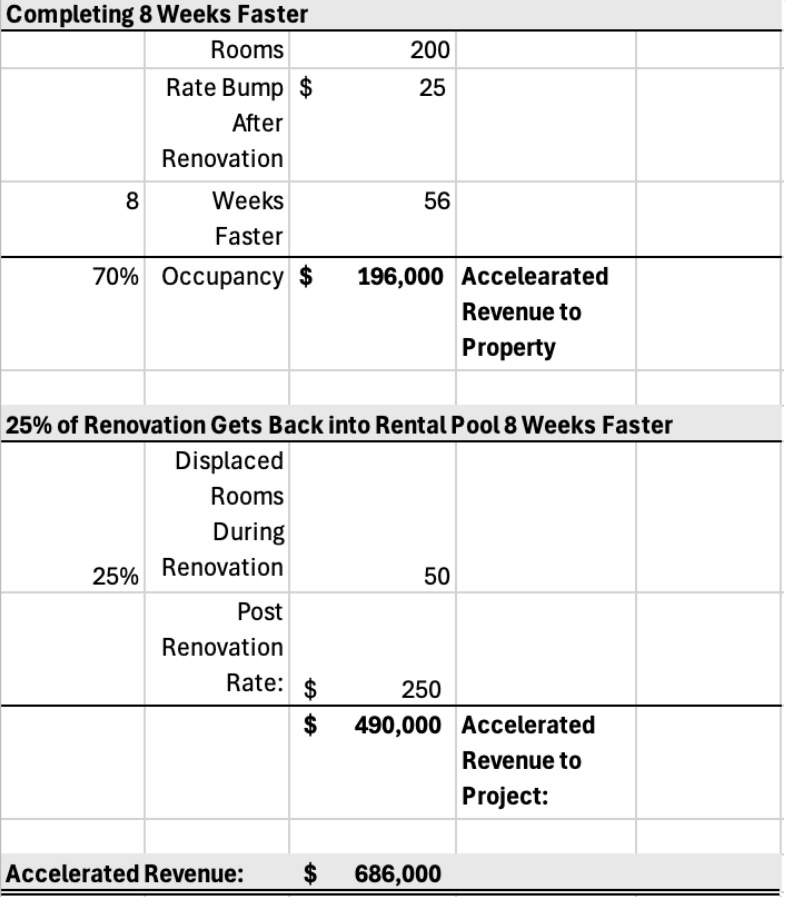
Even if you discount that and assume you only save 8 weeks, the math gets interesting very quickly.
A simple, conservative, example (nota bene - I’m not a finance guy):
• 200-room hotel
• $225 ADR
• 70% occupancy
• $25 rate lift driven by renovation
• Rooms returned to the rental pool 8 weeks earlier
That could be conservatively almost $700,000 in incremental revenue returned to the property purely from time saved.
And that’s before considering:
• Leverage
• NOI capitalization
• Speed to “stabilization”
• Downstream impact on valuation
In many cases, that return is 5 to 10 times what a team might save by squeezing these long-lead items through a traditional competitive bid process.
For these long-lead items, especially casegoods and seating, the project already knows the budget. Share it. Give the greenlight. Design and build to it. Don’t exceed it. And unleash the returns to the capital stack on the project.

If you accelerate a project by six months on an 18 to 24 month timeline, the upside compounds even further.
This Isn’t About Skipping Process
To be very clear, this is not a critique of the traditional process.
Project teams are built this way for good reasons, and we are highly effective. This approach also does not work for every project, in fact I posit that it doesn’t work for most projects. If I were to guess, maybe 5-10% of Luxury & Lifestyle renovations. Some ownership groups, REITs, and capital partners require competitive bids, and have other by-laws and convenants that cannot be altered.
The real question is at what opportunity cost?
The types of projects this works for:
• Schedule-driven renovations: start construction in San Francisco on Super Bowl Monday and reopen just before the World Cup comes to town this summer.
• Assets where time-to-revenue materially outweighs line-item optimization
It’s worth asking a different question:
Have we considered a single-source, fast-track strategy for our longest-lead items?
When the right partners are involved early, with transparency around budget, schedule, and expectations, this approach doesn’t increase risk:
It reallocates RISK earlier, when teams still have room to maneuver, and allows you to work with more partners that you know, like, and trust.
Proof From the Field
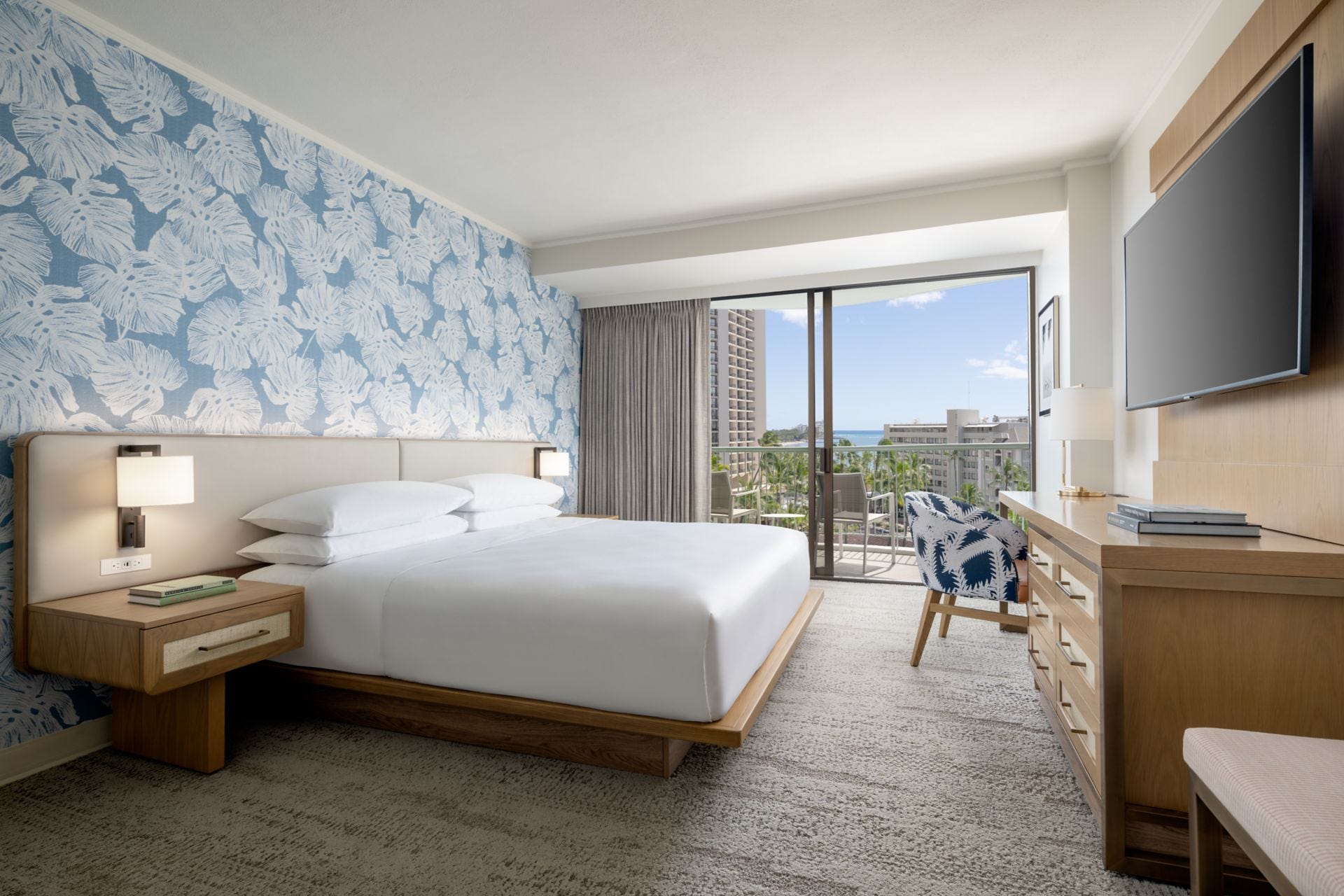
At BERMANFALK, we’ve now executed a handful of projects this way over the past couple of years, and the results have been remarkable.
From the moment ownership gave the greenlight to:
• Project Managment
• Design and Procurement
• Preconstruction
• Model room kickoff
To the moment the last containers of rollout furniture are being delivered, the total timeline was under one year.
That includes:
• Model room
• Production
• Full rollout
• Deliveries to Hawaii, the West Coast, and East Coast of the United States
It does not change production time.
It does not eliminate the time spent making sawdust.
What it does eliminate is unnecessary waiting between decisions and allows for compressed approval times.
Why This Panel Lit Me Up
This panel was deeply aligned with something I care about: I love connecting people.
But what lights me up even more is shortening journeys.
Shortening the journey of a project.
Shortening the journey from capital deployed to revenue realized.
Shortening the journey for owners carrying risk longer than they need to.
Talking with ALIS and ALIS Design+ attendees about how BERMANFALK has approached certain projects this way, the reaction was consistent: curiosity, excitement, and relief that someone was willing to rethink the sequence.
Not to blow things up.
But to make projects move faster, smarter, with fewer surprises and less risk.
Final Thought From the Front Row
This panel reinforced something I’ve come to believe strongly:
Great projects don’t just manage risk.
They front-load intelligence.
When teams align early around “BS”, and then selectively pull forward the right long-lead decisions, they don’t just avoid problems.
They create momentum.
If you’re curious what this can look like in practice, I’m happy to share more. I’ve got a presentation that walks through the approach, the math, and the trade-offs.
And if nothing else, it’s a reminder that oftentimes the fastest way to reduce risk is to stop waiting.
Solid breakdown on fast-tracking long-lead items. The revenue calcuation for 8 weeks saved makes the traditional competitive bid process look shortsighted on schedule-driven projects. Interesting how the risk allocation shifts but doesn't necessarily increase when partners are involved earlier with clear expectations.