

If yesterday’s Senior Team Panel was about the shift from fortress to family, this morning’s session was about what holds the fortress together in the first place: disciplined capital allocation, and a sustainability strategy that’s quietly become one of the best-returning investment programs in the portfolio.
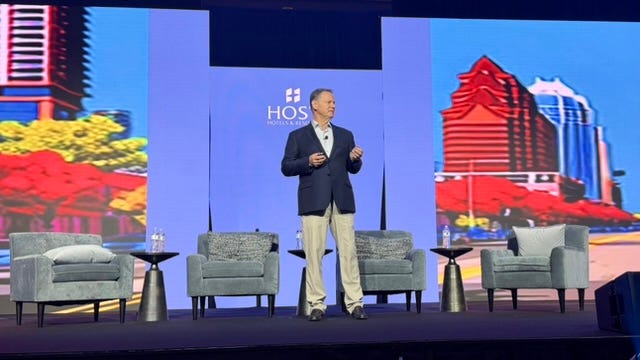
The session was led by Mike Lentz, EVP of Development, Design & Construction, Justin Ried, SVP of Pre-development, Design & Construction, and Michael Chang, First Vice President of Sustainability & Resilience. Between the three of them, they walked the room through roughly $3 billion in recent and active capital programs, a sustainability platform generating double-digit cash-on-cash returns, and a resilience strategy that turned a hurricane-ravaged hotel from a 10-month closure into a 9-day reopening.
On the eve of Earth Day, that sentence really resonated with me.
The Transformational Capital Programs
Let me start with the renovation story, because the numbers are pretty powerful. And I’ve been fascinated with these programs since they first started.
Host created what they call Transformational Capital Programs (TCPs): large-scale renovation partnerships with their brand operators (Marriott and Hyatt) that go well beyond a typical soft goods refresh. These are full repositionings: lobbies, food and beverage, meeting space, guest rooms, arrival experience, the works. And they come with a deal structure that makes them pencil, where everyone wins (one plus one equals three, or maybe even more, as I like to say): operating profit guarantees from the brand during construction disruption, and a clear target of 3 to 5 points of RevPAR Index Share gain post-renovation.
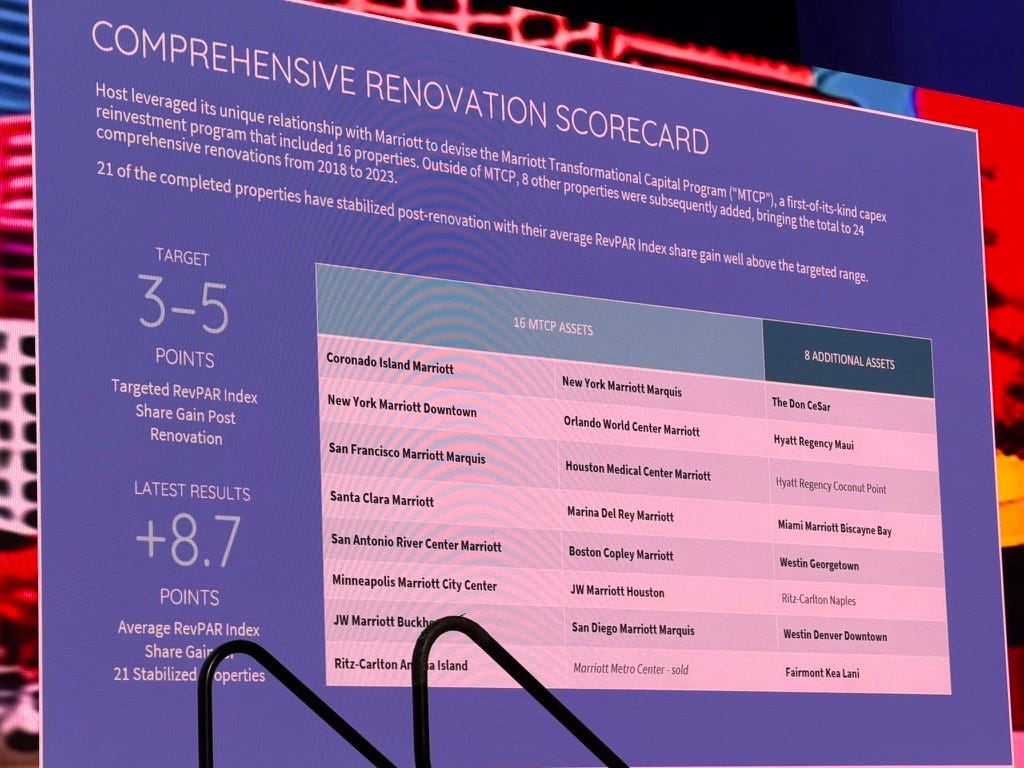
Here’s the thing: they’re not just hitting the target. They’re doubling it.
Mike Lentz showed a slide he first used at the 2024 GM Meeting in San Francisco (I remember it). Back then, they had stabilized data on only a handful of completed projects. Now they have 21. The average RevPAR Index Share gain across those 21 properties is 8.7 points, more than twice the midpoint of their 3-to-5-point target. That’s not a rounding error. That’s a thesis being validated at scale.
The Hyatt Transformational Capital Program (HTCP) covers six properties with over $550 million in total investment. By bundling procurement across more than 4,500 guest rooms (case goods, showers, LVT, carpet, etc) and consolidating consulting services, they saved over $10 million before a single room was touched. Four of the six properties are complete, with Grand Hyatt Washington and Grand Hyatt Manchester, San Diego on track for year-end.
The Marriott Transformational Capital Program (MTCP2) extends the playbook to four more properties (New Orleans Marriott, Ritz-Carlton Naples Tiburon, Ritz-Carlton Marina Del Rey, and Westin Kierland) at $300 to $350 million total. All four will have construction underway by late summer.
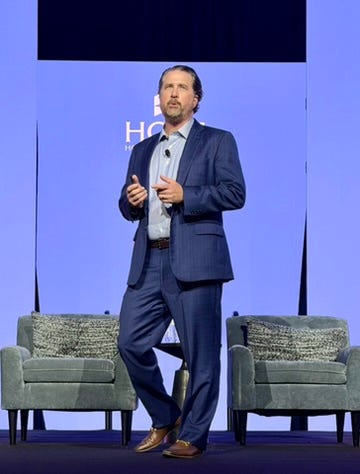
Justin Ried walked through the design details on several of these, and what stood out to me wasn’t just the finishes (though the renderings for Kierland’s lobby bar and the Ritz-Carlton Marina Del Rey’s club relocation are sharp). It was the intentionality. Every decision, adjusting floor levels at Kierland to add lounge seating, relocating the Ritz-Carlton Club to the lobby level at Marina Del Rey and converting the old space into four new keys, was underwritten against a return. Nothing decorative for the sake of decorative.
That’s the discipline. And as someone who’s worked on projects like the Grand Hyatt Manchester, Marriott Marquis San Diego, and Marriott Boston Copley with Host through BERMANFALK (something like 3,000 rooms across those), I can tell you: that discipline shows up in every coordination meeting, every design review, and every punchlist walk.
Sustainability as a Returns Story
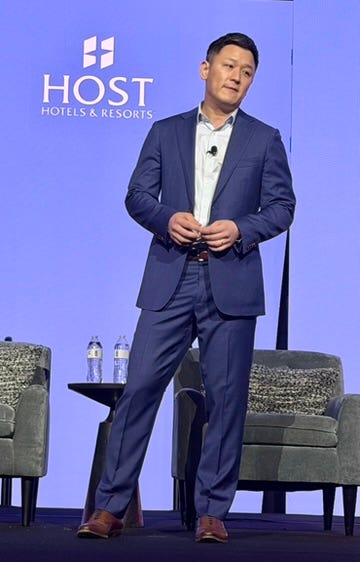
Then Michael Chang took the stage, and the morning shifted from impressive to important.
Because here’s the thing about sustainability in hospitality right now: the conversation has gotten quieter in some circles. The political winds have shifted. Some companies are pulling back on ESG language. And you could argue that makes it easier to just… not talk about it.
Host is doing the opposite. And they’re doing it by leading with the math.
Michael framed sustainability not as a compliance exercise or a branding play, but as a capital allocation discipline. His opening line set the tone: “these investments are not about checking a box. They’re about protecting operations, reducing disruption, and improving performance.” Every project is underwritten the same way a renovation is.
The numbers back it up:
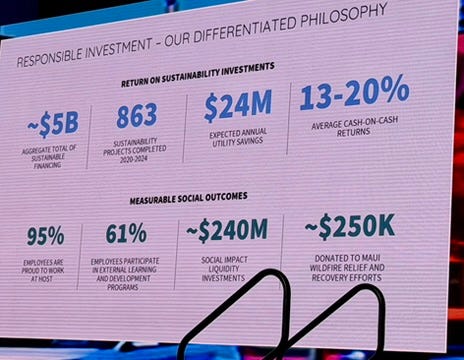
Green Building. Host helped pioneer LEED certification for existing, operating hotels, partnering with the US Green Building Council over a decade ago to develop an alternative compliance pathway. Today, about a third of their portfolio is LEED certified. That’s roughly 9 million square feet of certified hotel space, 25 properties with 5 at LEED Gold, and 9 more in the pipeline with a goal of 40% by 2030.
Solar. 14 properties with onsite solar Photovoltaics in operation, 8 more in development, supported by approximately $12 million in rebates and incentives. Cash-on-cash returns range from 10 to 35%. Those aren’t sustainability returns. Those are great returns no matter how you cut the cake.
AI-Powered Energy Management. For nearly a decade, Host has been using AI and machine learning with connected sensors to give engineering teams real-time visibility into HVAC, central plants, and water systems. A pilot across three properties generated about $700,000 in annual utility savings. They’re now scaling to 30-plus hotels, with an expected initial reduction of 8.5 million kilowatt hours and $1.5 million in savings.
Sustainable Financing. Host has been issued nearly $5 billion in sustainable financing, and the green building and renewable energy programs directly support the terms. Michael made the point that successful execution on solar and LEED projects helps meet annual targets in their sustainability-linked credit facility, which reduces their interest rate. So the sustainability investments are literally lowering their cost of capital. That’s a flywheel, and you know how I love flywheels.
And here’s the context that makes all of this more urgent, not less: surging electricity demand from AI data centers is driving energy prices up across the country. The hotels that have invested in onsite generation and energy efficiency aren’t just being responsible. They’re insulated.
9 Days, Not 10 Months
Then Michael told the Naples story, and I noticed a change in the room
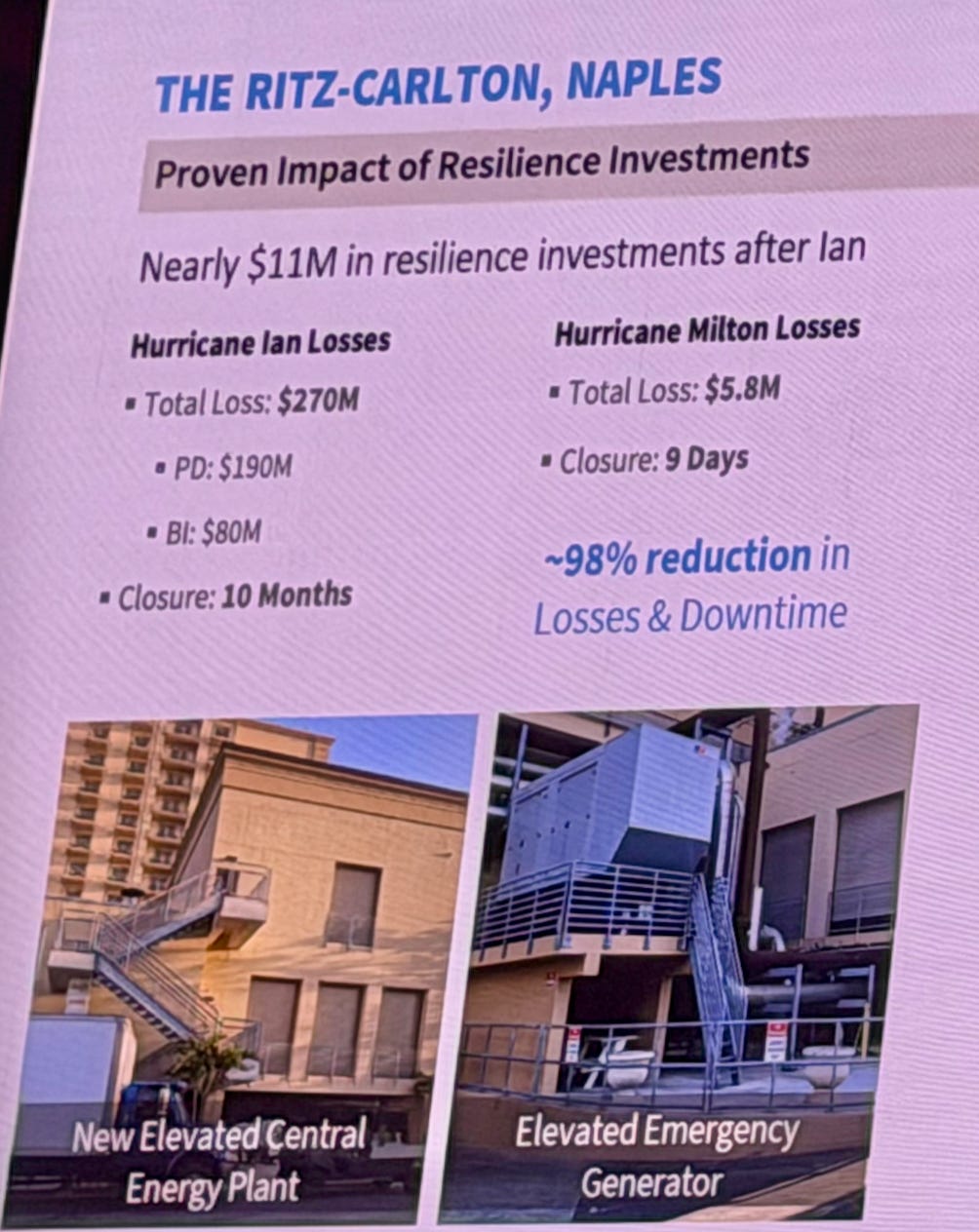
In 2022, Hurricane Ian hit the Ritz-Carlton Naples. Total losses: $270 million. The hotel was closed for 10 months.
After Ian, Host invested nearly $11 million in resilience measures at the property: elevating the central energy plant and generators, installing comprehensive flood barriers, and accelerating planned CapEx to strengthen the building envelope.
In 2024, Hurricane Milton brought a comparable storm surge to the same property. This time, total losses were $5.8 million. The hotel reopened in 9 days.
That’s a 98% reduction in both losses and downtime. Same property. Similar storm. Different outcome, because of the investment.
Michael’s line on it was simple: your teams and strategies are the difference between a 9-day reopening and a 10-month closure.
Host is now applying this playbook across the portfolio. They’ve screened every property using third-party climate analytics, prioritized 24 hotels representing about a third of their EBITDA, identified more than 60 resilience opportunities, and advanced 32 projects. They’re developing resilience plans for properties in four markets with elevated climate risk, covering flood barriers, utility redundancy, MEP relocation, and wildfire protection.
This is the part that connects back to yesterday’s conversation about the human element. Resilience isn’t just about hardening a building. It’s about being able to open your doors. For guests, for displaced families, for your own employees. Mike Lentz said it yesterday, and Michael Chang proved it today with the data.
The Thread
What struck me about this morning is how tightly it all connects. The transformational capital programs, the sustainability investments, the resilience strategy: they’re all running through the same discipline. Every dollar is underwritten. Every project has a return target. And every outcome depends on the teams in the hotels executing it.
Michael closed with a line that could have been the title of the whole session: every capital investment, whether it’s development, renovation, or sustainability, ultimately depends on you to turn that investment into performance.
That’s the ROI of doing it right. Not just spending the money. Spending it with intention, backing it with data, and trusting the people on the ground to deliver.
Host isn’t just maintaining a fortress balance sheet. They’re reinvesting it, intelligently, into a portfolio that’s more competitive, more efficient, more resilient, and more valuable than it was two years ago.
And they’re telling us about it on the eve of Earth Day, which feels like exactly the right time to say: this is what it looks like when sustainability isn’t a slogan. It’s a P&L line.
Having been an LP in several select service properties, and GP in a Hilton Garden Inn, this model makes a lot of sense to me, particularly bundling procurement. PIPs were always so painful, and brand standards such as how high an outlet socket needs to be seem to change as frequently as a flag’s marketing director. A company that is making that process smoother for franchise owners is a smart play.