

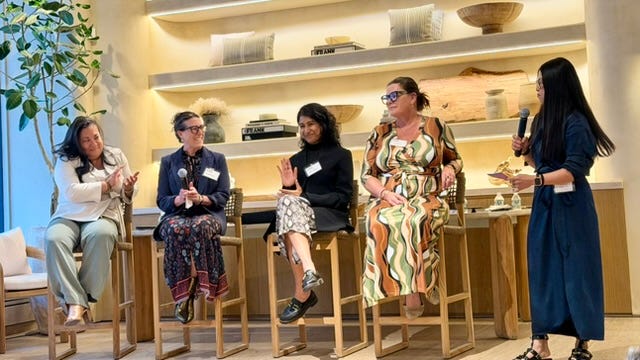
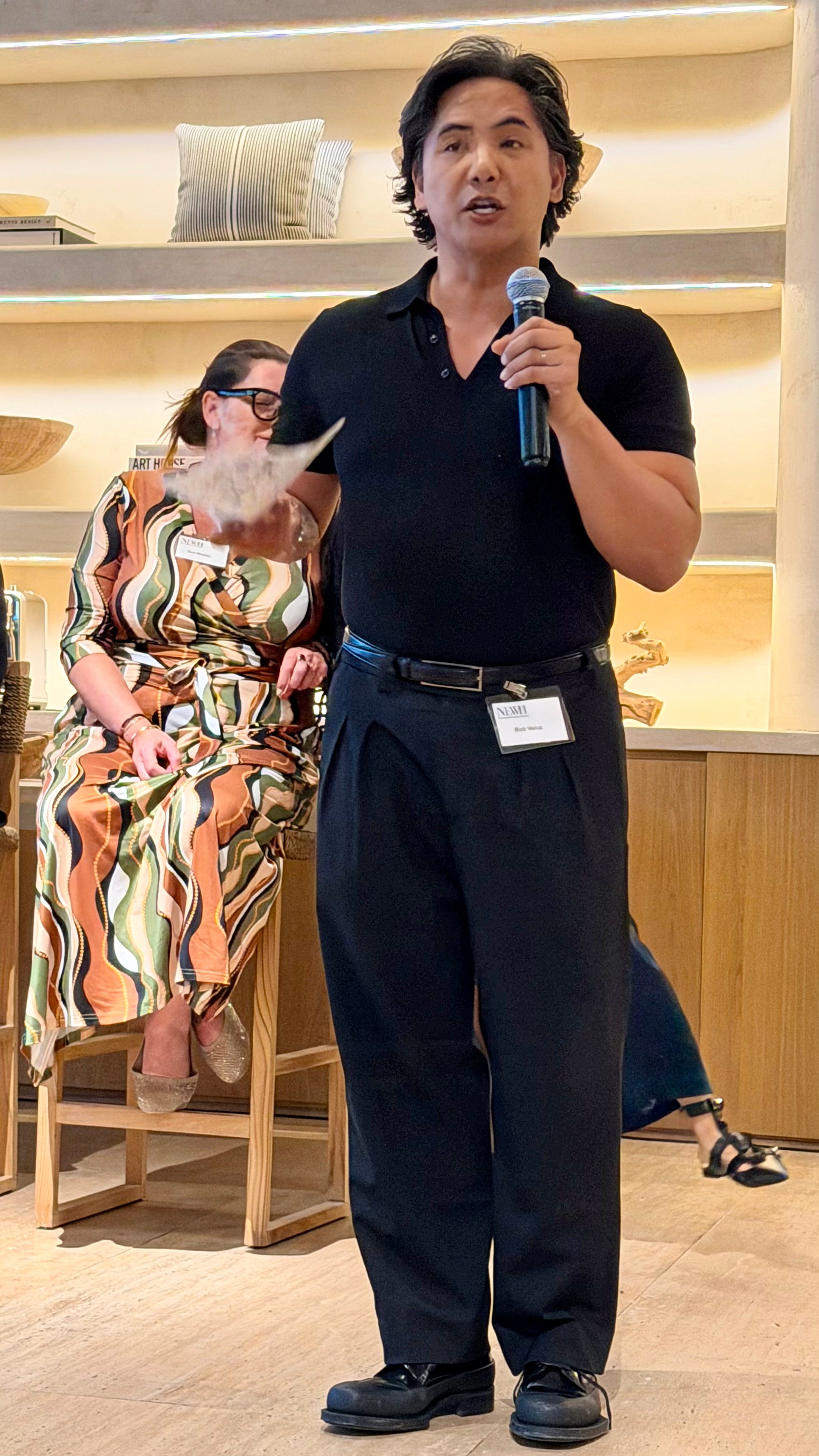
Last night was NEWH New York’s Women Making Moves in New York City. Four women on stage, all now leading hospitality work from very different seats: Caz Walker at Harbour Outdoor, Monica Kumar at Extell, Linda Laucirica at Marriott, and Diane Nguyen at Highgate. Rob Veluz and Miles Sotelo Hodge moderated, and they did a beautiful job of it, warm and fun, which is what these nights need to be.
Before I get into what was said, a quick word about NEWH. NEWH has been building the scaffolding and connective tissue of our industry for decades: scholarships that change lives and provide incredible visibility for the recipients, chapters that turn strangers into colleagues (and sometimes mentors and mentees). Events like this one pull people out of their corners long enough to remember we’re all working on the same thing. If you’re in hospitality and not yet plugged in, fix that by signing up at www.newh.org.
Now, here’s what the hamsters were running around in my head on the way home.
All the world is a stage
Linda opened a door I didn’t see coming. When the moderators asked how she came to be in hospitality, she went further back. She started in theater. “All the world is a stage,” she said, quoting Shakespeare but meaning it literally. Design, she said, has always been, intrinsically, about storytelling. Space is a character. The guest is the audience. Every choice, the fabric, the fixture, the lighting cue when someone sits down at the bar, is a choice in service of the show.
Diane picked up the thread, or should I say the Playbill. A restaurant is a theater. We come in, we’re cast in a role for the evening, we watch other people play theirs, and when we leave, we’ve been in a production whether we realized it or not.
What’s interesting: these two also came from the Rockwell tribe, and both consider Rockwell one of the most formative experiences of their careers. Rockwell, as you’d expect, does a lot of theater design.
Because we talk about hospitality in so many technical registers, operations, margin, F&B covers, RevPAR, programming, FF&E, and sometimes we forget that what we’re actually doing is staging a performance for a stranger who paid to be here - every single night. The designer is the set designer. The operator is the director. The GM is the stage manager, making sure the cues land.
Monica said it a different way. Her winding path from workplace design to hospitality taught her to design from the point of view of feeling, not from the point of view of the plan, the elevation, or the spec. Start with what the guest should feel. Reverse-engineer the room from there.
On mentorship
I asked Caz a question about mentorship because earlier that evening, I’d learned she mentors someone I know well. Someone who, on paper, you’d call a competitor of hers. I’ve sat in on how this person runs a monthly meeting, and I walked out of it changed. That kind of coaching doesn’t happen by accident, and it certainly doesn’t happen because people are guarding their territory.
Her answer was simple, and I think the whole room benefited from her knowledge: when you listen, you learn; when you learn, you grow. Mentorship, for her, is about guiding, giving direction, and modeling how to live the mission.
I think we all have more room for mentors than we give ourselves credit for, both in receiving it and in offering it. The question isn’t whether we can afford to make the time. The question is whether we can afford not to.
And this doesn’t need to be a formal practice. Call it coaching, call it mentoring, just make space. It doesn’t need to be robotic. I learned some great tools many years ago that I’ve been dusted off again, and I want to give a nod to Aaron Berman for the reminder earlier this week. If you haven’t read Trust & Inspire by Stephen M.R. Covey, pick it up.

Rockwell as a Tribe
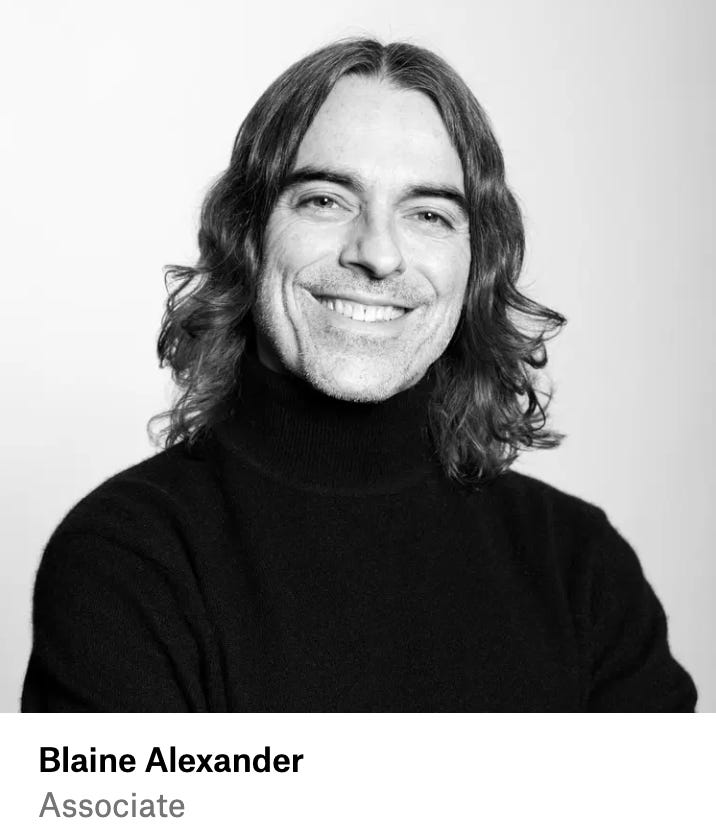
Funnily enough, I’d been inside Rockwell Group’s office earlier that same day, so when Linda and Diane both traced their origin stories back to it, the word Tribe resonated powerfully with me. You can feel it when you walk in there. There’s a house. There’s a craft. There’s a lineage. (Hooray to Blaine Alexander, who I think has been there since the Appalachian mountains were formed, which are, by the way, the oldest mountains in the world. The place would not be the place without him. And somehow he looks younger and younger every time I see him.) Every one of the panelists had clearly been shaped by that tribe and then gone off to build something of their own with the lessons.
That’s what a great firm does. It doesn’t try to keep you. It makes you ready to go. And Rockwell has a strange gravity that brings many back, even after they’ve tried something else.
This is also why last week’s episode with Ed Bakos, CEO of Champalimaud Design, landed the way it did. Ed also got his start at Rockwell, and the DNA shows up in how he talks about anticipation as the real currency of hospitality. If you haven’t listened yet, it’s worth your commute. I was also surprised to learn he worked on Rockwell’s first hotel guestroom project - the W-Lexington - which was also the first W and ties back to Linda’s full circle, starting on W Hotels and now back on the team as W reinvents itself.
Linda said something else I want to hold onto: NEWH has been the backbone of her career. She left hospitality design for a while and came back to it, and NEWH was the through-line. Communities like this one aren’t extracurricular. They’re load-bearing. (That reminded me of the “spinal cord” framing from the Marriott rebrand panel Linda moderated, which I wrote about in my Waffle Maker piece. Same idea, different angle: the support structure is the thing.)
The lightning round
At the end, each panelist was asked for one word to describe the future of hospitality.
Linda’s answer: intentional.
I’ve been using that word a lot lately. It anchored my Q1 recap two weeks ago, I’ve been wearing it out in client conversations, and hearing it come back from the stage felt like confirmation. If all the world is a stage, intention is the only way to direct it. There is no set design by accident. There is no guest experience by accident. Either you meant it, or it fell together, and if it fell together, the audience can tell.
Start everything with intention. A task, a project, a coaching session. It doesn’t take much. Just pause and be deliberate.
Diane closed the panel with the line I highlighted twice in my notebook:
Enjoy the show.

I think that’s the whole can of beans. Every project is a show, started by the playwrights of intention, orchestrated into what can be an incredible experience.
I’ll be thinking about this one for a while. Or at least the hamsters in my head will.
Huge thanks to Caz Walker and the Harbour Outdoor team for hosting, to Rob Veluz and Miles Sotelo Hodge for moderating with such care and humor, and to Monica Kumar, Linda Laucirica, and Diane Nguyen for generosity with their stories. And to NEWH New York for continuing to build the tribe we all benefit from. If you want to support the work, their scholarship program is the place to start.