

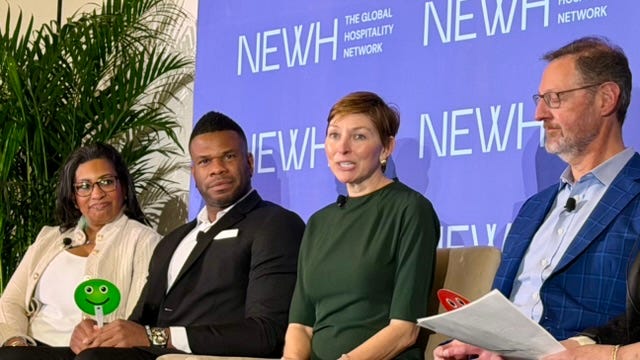
The second panel I want to write about from the NEWH Leadership Conference in DC was called Myth Busting the Modern Hotel Project. Moderated by Trisha Poole of Design Poole, the panel brought together Alan Benjamin (Benjamin West), Aaron Anderson (The 26 Company and former Defining Hospitality guest), Heather Ciszcon (CoralTree Hospitality and former Defining Hospitality guest), and Meridith Zimmerman (RLJ Lodging Trust). Ownership, project management, procurement, and operations all in the same room, all on the same stage.
The premise was simple: name the things our industry believes that might not actually be true, and then talk about them honestly. And the panel delivered. But as I sat in the audience, scribbling in my notebook, I kept circling back to one question nobody on stage addressed: if the whole conversation is about saving time and money, why is no one talking about the fastest lever we have?
More on that at the end. First, what they got right.
Myth: “It’s Costly to Align Consultants Early”
Aaron Anderson framed this one clearly. He wants all consultants on board from day one, including procurement, engineers, lighting, everyone. His logic: the fee will be the same whether you bring someone on at the start or three months in. The only thing that changes is how efficiently the project runs.
Alan Benjamin reinforced this with what he often cites as one of his most important metrics: the “ROT” model, Return on Time. The more information you have on the front end, the less ugly the value engineering gets on the back end. His worst-case example: a designer works for months, buys a model room full of items the owner can’t afford, with durability that won’t hold up, from a vendor that’s running late on 10 other projects. Then procurement comes in and the whole thing gets redesigned. That’s not a cost savings. That’s a cost explosion.
Meridith Zimmerman, from the ownership side at RLJ, put it simply. Get everybody on the same page at the same time. Same objectives. Same budget. No go-backs. She called having the full team aligned from the beginning “vital, golden.”
And Heather Ciszcon of CoralTree added a layer I appreciated. Before you assemble the team, define the vision. Is this a generational hold? A 10-year flip? That intent should shape every decision that follows, from the casegoods you specify to how long the design needs to last.
The room overwhelmingly agreed when they polled us. Green smiley faces everywhere. Nobody was arguing against early alignment. The myth was thoroughly busted.

Tariffs, Costs, and the 40% Question
This is where it got interesting. The myth on the table: project costs are up 40 to 50 percent because of tariffs.
Aaron was direct. He hasn’t seen a project stop because of cost, and the increase everyone is feeling is mostly on the construction side: labor and materials are up roughly 30% from pre-COVID levels. From an FF&E standpoint, the tariff impact on goods has been real but not the project-killer the headlines suggest.
Alan Benjamin, who does 250 to 300 projects a year through Benjamin West, confirmed it. He’s not aware of a single project that was a no-go solely due to tariffs. The much bigger issue for renovations is the mechanical infrastructure: chillers, boilers, roofs, kitchen equipment, elevators. That’s where the massive capex decisions live.
He also offered some historical context that I think the room needed to hear. Anti-dumping tariffs on Chinese casegoods have been in place since 2004, in some cases up to 200%, going back to the Bush administration. Those tariffs stayed in place through Obama, Trump, Biden, and now Trump again. The 2018 tariffs were layered on top. And every yard of fabric for the last 35 to 40 years has carried roughly a 15% tariff baked into the price, it just wasn’t discussed.
I was called on in the audience by Trisha. I don’t remember raising my hand! Perhaps it was because I was in the front row and was holding up my green smiley face emoji. She asked whether we’ve seen projects get 40% more expensive in the more recent age of tariffs. My honest answer, with a little more time to think about it: the average order size at BERMANFALK has increased about 25% over the past seven years. But I think much of that is because we’ve been working on increasingly large projects as we continually strive to delight our clients and improve our processes. So yes, things cost more. But the why matters, and it’s not just tariffs driving the number.
I also added that from 2001 to 2020, there was essentially no inflation in our industry. If you spread the increases we’re seeing now over that 20-year flat period, it’s not as dramatic as it feels. Another manufacturer shared that they went to their mill in China and said, “you’ve got to help us, we have to keep our standard.” And the mill cooperated. Relationships matter, even at the factory level.
Myth: “Design Suffers When Budgets Are Tight”
Meridith’s answer to this one was refreshingly direct. Share the budget. Tell your designers where you’re willing to spend and where the limits are. RLJ has actual manufacturer programs with preferred pricing that they share with their design teams. No surprises.

Alan was even more blunt. If the budget is $8 million and you design at $8.5 million, a competent procurement agent can get you to the promised land. But if the budget is $8 million and you design at $20 million, the chair will still have four legs, but nobody’s happy at the end of the job. And Meridith added: if you design an $8 million project at $20 million, you’re probably not getting the next call.
Heather framed it well: not everything in a room can be the star. Define your star, focus your dollars there, and let the rest be good and functional. Sometimes the most important design decision isn’t the headboard. It’s putting the hook in the right place so you have somewhere to hang your towel when you get out of the shower.
Aaron’s advice to every designer listening: if you get an RFP and it doesn’t include a budget, don’t start until you have one. It is the most important piece of information you can have.
The Wedding Photographer and the Model Room
The model room was referred to as the wedding photographer of the wedding. You cannot miss the wedding.
The panel was unanimous. Model rooms are where relationships get tested, where you see if a vendor’s shop drawings are on time, where you discover what’s hiding behind the walls (leaks, rust, delaminated drywall), and where the design gets that last 5 to 10 percent of refinement that turns a nice room into a wow room.
Alan made a point I think every designer and owner should hear: even if you give the same spec to two legitimate casegoods vendors, the design engineer at each will interpret it slightly differently. You might prefer the flitch of the grain from one, the drawer glide from the other, the hardware from a third. That last 5 to 10 percent of quality, what he called the “star moments,” comes out of the model room process. And most of the time it doesn’t even affect cost.
The consensus: it costs you more to skip the model room than to do one.
Relationships Over Transactions
This theme ran through the entire panel. Meridith talked about how RLJ builds long-term relationships with vendors and manufacturers, not just chasing the lowest bid. When they find a vendor that delivers, they use them again and again. And they share those relationships with their designers.
Heather reinforced this: when you think of your partnerships as relationships rather than transactions, everything changes. If an owner is writing a half-million-dollar purchase order, they should have a relationship with that manufacturer. Not just a line item on a spreadsheet.
One of the manufacturers in the room raised a question that I think a lot of vendors feel but rarely say out loud: sometimes the designer is the gatekeeper, and they won’t let the manufacturer get to the owner or even the procurement agent. How do you break through? Aaron’s answer was honest: events like this. Person to person. There’s no other way.
Alan added something important from the procurement side. He wants the owner to have the most direct relationship possible with each vendor. When Benjamin West is doing the bid comparison, they want full transparency: lead time, quality, cost, payment terms. If another player on a project is blocking that transparency, that could be a red flag.
AI: Not There Yet
Aaron got the AI question and gave what I thought was the most grounded answer I heard at the conference (and this is the second panel in a row where I’ve said that). He uses AI for research, for Excel models and formulas, and he name-dropped Claude, which made me smile. But for actually managing a hospitality project? “We’re not there.”
He wasn’t dismissive. He was specific. AI is useful as a tool for certain tasks, but the way hotel projects actually get managed, the relationships, the judgment calls, the ability to walk a site and know something’s off, that’s not something a model can replicate today. He’s hopeful and optimistic, but not convinced. I think that’s exactly the right posture.
The Question Nobody Asked
So here’s what kept running through my mind the whole time.
The panel spent an hour making the case that early alignment saves time and money. Get consultants on board sooner. Share the budget. Build consistent teams. Define the vision. All of that is correct, and I agree with every word of it.
But nobody mentioned the single fastest way to accelerate a hotel project timeline: bringing your long-lead FF&E items forward.
Casegoods. Seating. Lighting. Sometimes flooring. These are the items with the longest manufacturing and shipping lead times, and they’re the ones that sit on the critical path of nearly every project. If you pull them forward, if you get them specified, approved, and into production earlier in the process, you can compress a project schedule by 11 to 22 weeks. In some cases, up to six months.
Read my article here:
Notes from the Front Row: ALIS Design+ Procurement, Project Management, and How to Deflect the Unexpected

The session, Procurement, Project Management: What to Expect and How to Deflect the Unexpected, was moderated by Karin Harrington, with panelists Jennifer Chesek (Beyer Brown), Clif Dierking (PDSI), Neil Locke (Neil Locke & Associates), Jeff Mazmanian (Cumming Group)
The industry keeps optimizing around getting people in the room sooner, and that’s important. But there’s an equally powerful play on the product side. It’s not about hiring faster. It’s about ordering smarter.
Aaron talked about front-loading information and preventing back-end engineering. Alan talked about “ROT”, Return on Time. Heather talked about defining the vision early so the casegoods match the hold period. All of those arguments point in the same direction: if you know what you want, and you have the right team in place, why are you waiting to pull the trigger on the items that take the longest to arrive?
I say this with full respect for every person on that stage, some of whom are clients and all of whom I admire. The conversation was excellent. I just think the next chapter of it is about procurement sequencing, not just consultant alignment. And the numbers back it up.
The Front Row Takeaway
The Myth Busting panel did exactly what it promised. It named the things we accept as true and pressure-tested them in front of a room full of people who live this every day.
Consultants don’t cost more when you bring them on early. Tariffs are real but not new, and they’re not the reason your project is over budget. Good designers can work within any budget if you share it with them. Model rooms aren’t optional. And relationships beat transactions every single time.
But the biggest myth might be the one that wasn’t on the agenda: that we’ve already optimized the project timeline as much as we can. We haven’t. The long-lead items are sitting right there, waiting for someone to pull them forward.
That was the real takeaway from the front row.